
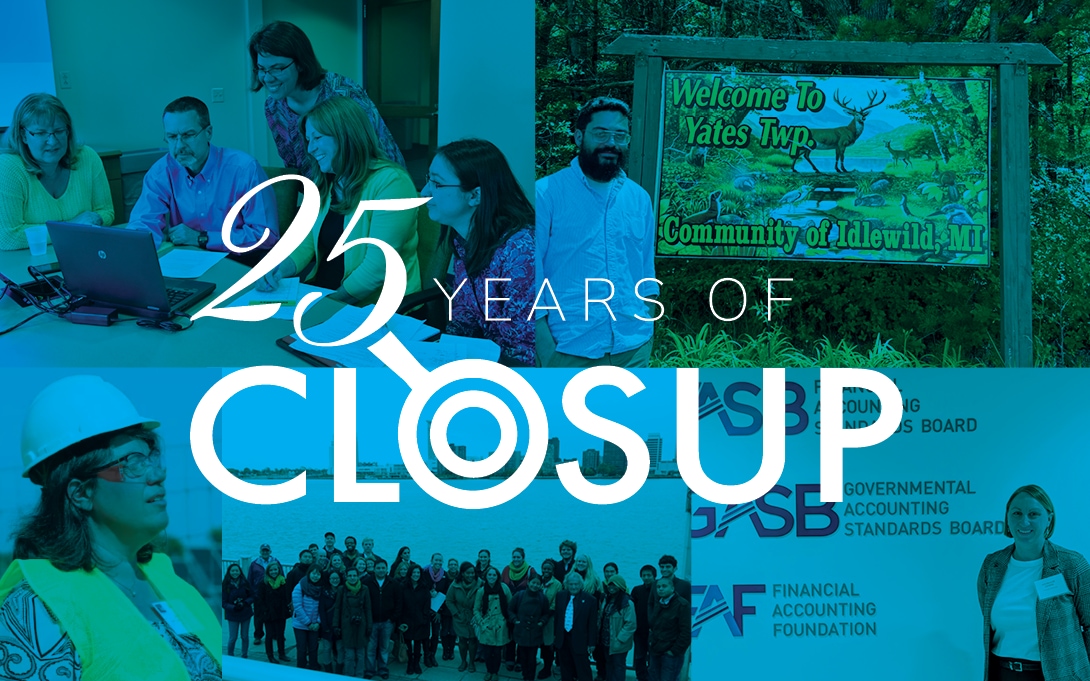
When the Michigan Independent Citizens Redistricting Commission faced a tidal wave of public input—more than 30,000 comments—the Center for Local, State, and Urban Policy (CLOSUP) and Ford School students stepped in. Their analysis helped the commission understand and respond to the voices of Michigan residents in real time, channeling public engagement into transparent, actionable policy. It's just one example of how, after a quarter century, CLOSUP continues to shape Michigan's communities with data-driven research, practical partnerships, and student-powered innovation.
How did this laboratory for applied policy come to be?
"From the very beginning, we thought applied research for state and local government is valuable, and it belongs in the policy school," recalls Paul Courant, who, as U-M Provost, helped launch CLOSUP 25 years ago.
Courant, former Institute of Public Policy Studies (IPPS) Director Ned Gramlich, and Congressman Joe Schwarz—then chair of the Michigan Senate's higher education appropriations committee—saw an opportunity to connect the university more deeply to its home state's communities.
They outlined how the new center would serve this role, ultimately securing legislative support to establish CLOSUP.
Gramlich strongly advocated for the center to reside within the Ford School. At the time, the Ford School was best known for its work on federal policy issues. But with the arrival of Elisabeth Gerber as inaugural director, it expanded its focus to applied, policy-oriented work focused at the state and local levels.
Setting the stage
In its early days, Gerber traveled across Michigan, asking, "How can the university help you? How can we partner together?" That outreach shaped CLOSUP's guiding philosophy: that policy research should be responsive, collaborative, and directly relevant to communities. This commitment laid the foundation for the center's future.
Data-driven growth

"One of the cool things about CLOSUP's history is that it serves as an incubator. Ideas take root with each new director and spread throughout U-M and beyond," says Tom Ivacko, CLOSUP's first staff member.
With Brian Jacob as director, CLOSUP became an incubator for statewide education research. Jacob adds, "CLOSUP helped launch the Education Policy Initiative (EPI) and the Michigan Education Data Center (MEDC) by providing the space and resources to build research-to-practice partnerships. We started projects that still shape education policy today." One notable project examined the Michigan Merit Curriculum's impact on graduation rates, laying the foundation for broader data-sharing agreements and ongoing research between U-M and the state.
In the wake of the Great Recession, Jacob worked with Ivacko and hired Debra Horner to launch the Michigan Public Policy Survey (MPPS). Their goal: provide a public service to Michigan's communities by capturing the viewpoints of local government officials—a crucial information gap in the policymaking process. Still running today, the survey regularly receives a 70%+ response rate from leaders of 1,856 counties, cities, townships, and villages on topics ranging from fiscal stress to trust in government, recycling programs, housing, and law enforcement. It remains the only ongoing survey of its kind, empowering communities to make informed choices, with all of its data available to policymakers, media, researchers, and professors.
"The data and reports produced through the MPPS have been invaluable to the League—helping us design programming that is impactful in real time," says Summer Minnick, deputy executive director and chief of staff for the Michigan Municipal League. "Armed with this knowledge, we can support our members with timely and relevant information and track long‑term trends affecting local fiscal health, operations, and community well‑being."
Energy and environment
During Barry Rabe's tenure, CLOSUP's incubator role extended into environmental and energy topics, including wind energy and fracking. Rabe recalls, "CLOSUP provided a platform for conversations and experiments that might not have happened otherwise."

The arrival of Sarah Mills, then a postdoc, reinforced CLOSUP as a launching pad for emerging leaders; her research on renewable energy siting and land use now influences state and local policy through the Graham Sustainability Institute's Center for EmPowering Communities. Mills and her colleagues partnered with Michigan's Department of Environment, Great Lakes, and Energy (EGLE) to develop the Michigan Local Energy Survey, using its data to develop new strategies to help local governments benchmark, network, and advance sustainability goals.
Democracy, fiscal health, & regional innovation
Under Ivacko's direction (2019–2024) and in partnership with Stephanie Leiser, CLOSUP launched its Fiscal Health Project in 2019 to address challenges in collecting, using, and interpreting data. "Fiscal health is critical because it underlies the ability of local governments to provide public services—from economic development to public safety, social welfare, clean water, and more," Leiser explains.
This focus became especially important during the financial uncertainty of the pandemic when CLOSUP offered guidance to municipalities navigating rapid changes. CLOSUP continues to be a trusted partner and leading academic voice on transparent financial reporting nationwide.
As highlighted in the opening, CLOSUP's expertise also proved invaluable to the Michigan Independent Citizens Redistricting Commission (MICRC)— through advice on conducting outreach, defining "communities of interest," and devising novel analysis methods to systematically process a surge of public comments in real time.
My vision is for a public service pipeline—students learning through real, hands-on experiences, then using those skills to serve communities across Michigan.”
Stephanie Leiser
What's next: Rural focus and expanded student engagement
Creating research and internship opportunities for students interested in state and local policy has always been central to CLOSUP's mission. Now, as director, Leiser is passionate about expanding practical learning. "My vision is for a public service pipeline—students learning through real, hands-on experiences, then using those skills to serve communities across Michigan," she says.

Looking forward, Leiser sees growing opportunities to support small and rural communities. "We have so much insight on operating with fewer resources—inter-local cooperation, budget transparency, and infrastructure needs."
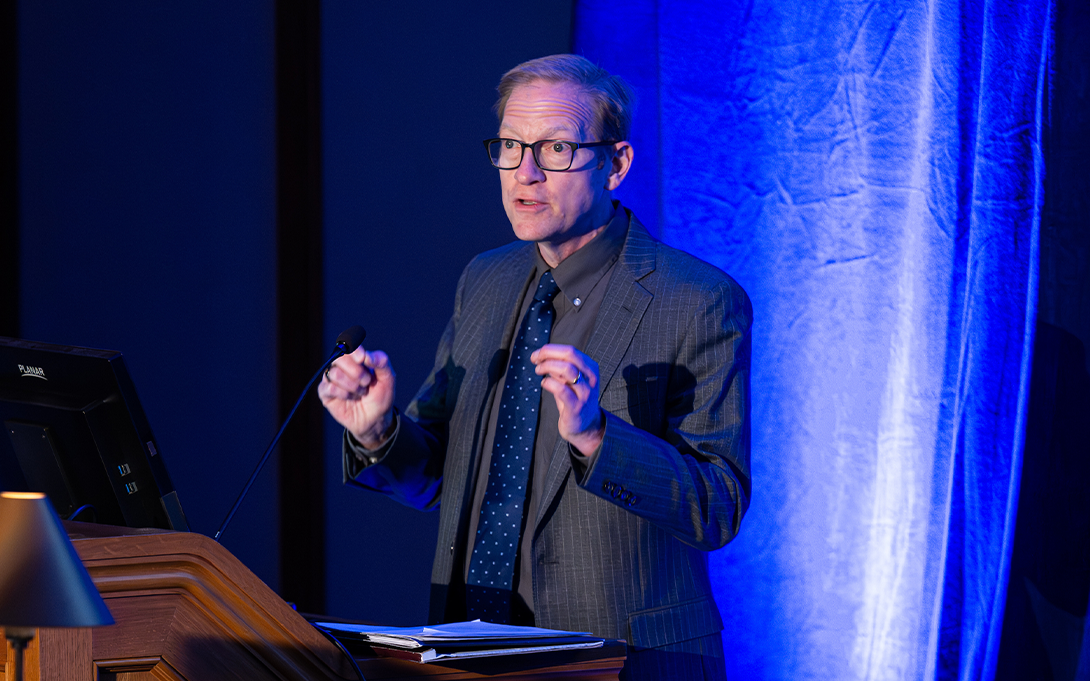
CLOSUP is uniquely positioned to study and support the everyday work of democracy in communities statewide. "When democracy is healthy at the local level, you see the ‘boring' but essential good government work happening—budgets are passed, meetings are held, long-term planning gets done, and things just click. Democracy is not just elections or turnout; it's the day-to-day functionality that keeps communities running," Leiser explains.
After 25 years, CLOSUP's commitment to Michigan's communities, evidence-based policy, and real-world student engagement has taken root and is ready to meet tomorrow's challenges.
By Rebecca Cohen (MPP '09)
Related spring 2026 State & Hill stories

← Read all stories in the spring 2026 edition State & Hill
More news from the Ford School