
From providing clean water to ensuring strong, sustainable infrastructure, local governments shape a majority of the programs Americans interact with everyday.
Yet the people leading Michigan's municipalities do not fully reflect the communities they serve: Although women make up more than half of the state's population, they hold fewer than a quarter of its local leadership roles.
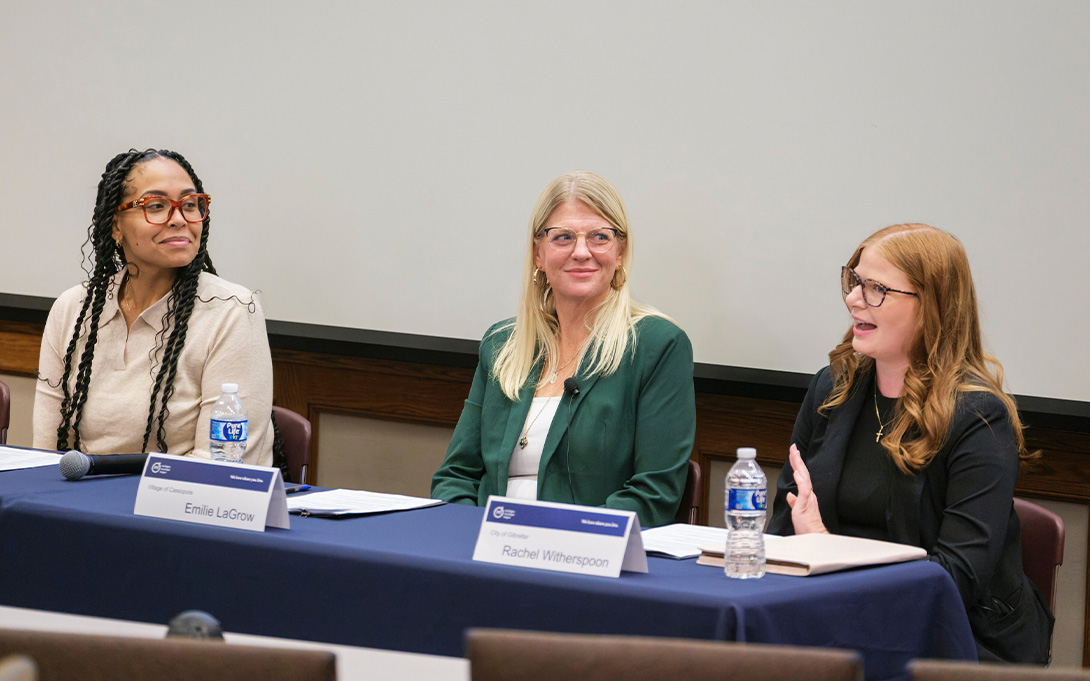
To help increase visibility of local government careers, the Ford School's Center for Local, State, and Urban Policy (CLOSUP), the Michigan Municipal League (MML), and their partners brought together influential women leaders from across the state. They included Emilie LaGrow, village manager at the Village of Cassopolis; Dr. Sheryl L. Theriot, city manager at the City of Albion; Mariah Walton, deputy city administrator at the City of Ann Arbor; and Rachel Witherspoon, city administrator at the City of Gibraltar.
The panelists discussed the future of local government, the importance of a representative government workforce, and the impact they are able to have in their own communities.
"There is no greater joy than seeing the impact that you're having on the people around you," Theriot said.
Students and U-M community members also had the opportunity to ask the speakers about their career journeys and lessons learned from local government and participate in an interactive simulation acting out government responses.
From managing city council interference in staff operations to maintaining public trust, participants learned what policy and communication tools elected officials employ when responding to community concerns.
Village manager LaGrow noted that building and maintaining relationships with residents and elected officials was key in building support for local programs—and for promoting respectful dialogue and disagreement.
"When you break bread together and find common ground, disagreeing is a lot easier," said LaGrow.

An overlooked path to public service
Municipal roles are often overlooked when students and young professionals consider public sector roles, said Emily Kieliszewski, assistant director of member experience & learning at MML.
"When people think about government careers, they often think about working in Lansing or Washington, DC, or perhaps running for elected office," said Kieliszewski. But there's an entire world of opportunity in local government, where so much of what affects our everyday lives actually happens."
The gender gap in local leadership has shrunk year over year—the number of women in local leadership positions has doubled since 2018, due in part to statewide initiatives like the MML's 16/50 Project, which aims to reduce barriers to and provide training for women's participation in local government.
"Women are still underrepresented in municipal management, so I think there's something powerful about showcasing women with diverse backgrounds who are succeeding in these roles," she noted. "Students get to see what's possible and have meaningful conversations with women who are actively doing the work."

Stephanie Leiser, director of the Ford School's Center for Local, State, and Urban Policy (CLOSUP) said she hoped students learned why participation in local government matters.
"Local government is a place where you can build a career that not only puts your policy skills to work but makes a real, tangible difference to people in your community every day," said Leiser. "We're living in a time of all-time lows of trust in national governments, large corporations, and other institutions, but studies—including our own—show that there's still a good amount of trust at the local level, and we think that's something we can build on."
As Michigan works to build a more representative municipal workforce, introducing students to those careers—and to the women already leading communities—is an important place to start.
The event was sponsored by the Michigan Municipal League, the 16/50 Project, the Gerald R. Ford School of Public Policy, the U-M Center for Democracy and Civic Empowerment, the U-M Ginsberg Center, the Ford School Leadership Initiative, and the Center for Local, State, and Urban Policy (CLOSUP).
More news from the Ford School